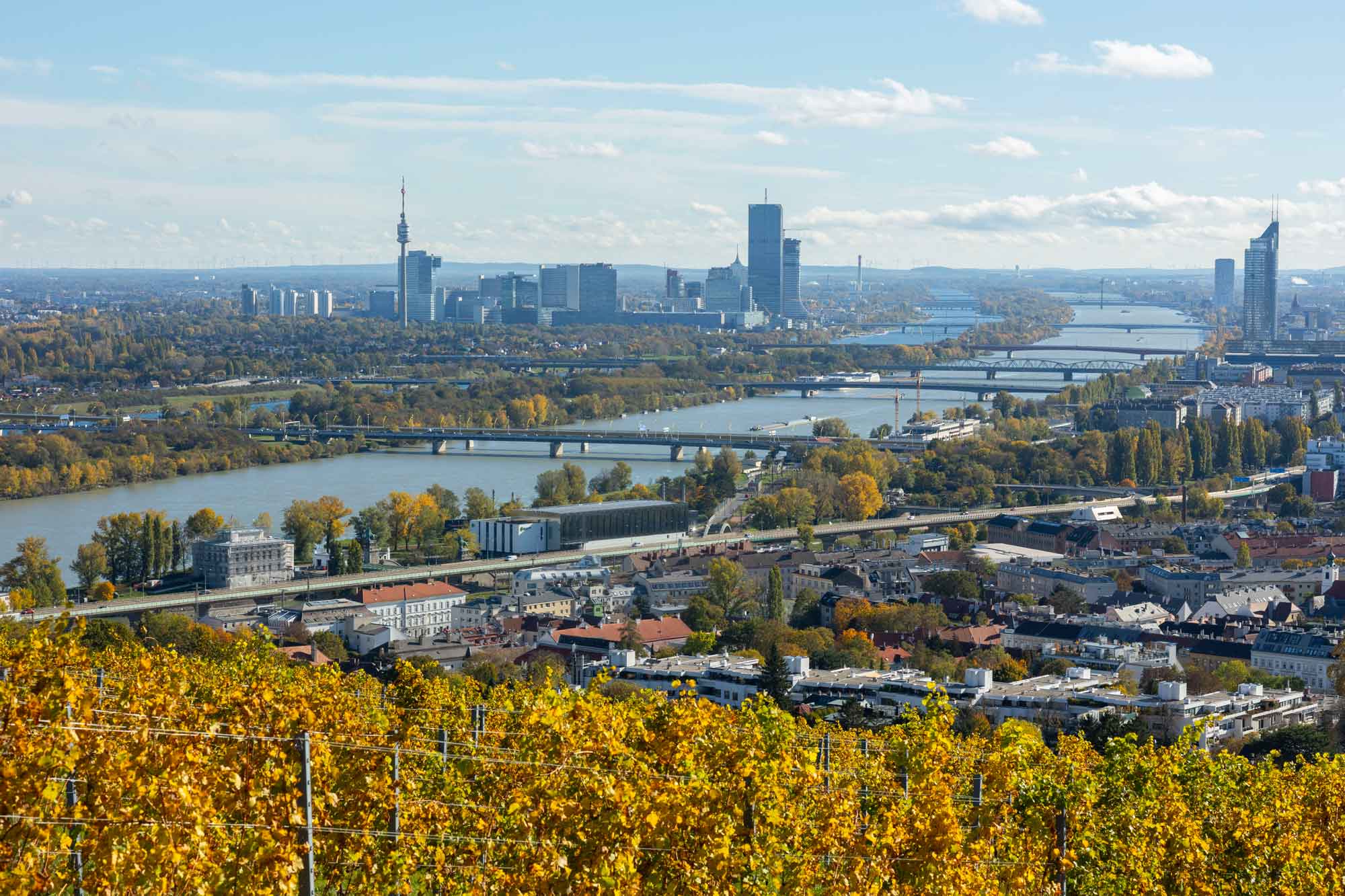
Within the “pioneering city” initiative, Vienna is focusing on leveraging synergy effects in order to lend maximum support to the city’s ongoing projects and develop them further. The topics range from calculating municipal greenhouse gas balances, refurbishment, phasing out fossil fuels and how to make the administration climate-neutral through to long-term process changes in the administration’s structure.
With the Smart Climate City Strategy adopted in 2022 and the Vienna Climate Roadmap, Vienna has defined how the city aims to become climate-neutral and climate-resilient by 2040. Its partnership with the BMIMI as part of the “Climate-Neutral City” mission is being delivered jointly by politicians and administrators via the “Vienna – climate pioneering city” programme and managed by the Chief Executive Office – Director’s Office for Climate Affairs.
“We’re focusing on municipal governance that’s relevant to the climate, on innovative concepts for transforming neighbourhoods and on learning together quickly and systematically,” explains Pia Minixhofer, who heads up the “Vienna – climate pioneering city” programme. “Everything we’re doing is aimed at gradually making Vienna energy- and resource-efficient, entirely in line with its climate targets.”
Enshrining climate neutrality in law
Vienna became Austria’s first province to pass its own Climate Act in 2025. The law enshrines the twin targets of achieving climate neutrality and a climate-neutral administration by 2040 and comprises three main pillars: climate protection, climate change adaptation and the circular economy. This has given the city’s existing climate policy strategies and instruments a legal framework. The law also emphasises the cooperation between research institutes, civil society, the private sector and regional authorities.
Tools and measures of relevance to the climate
The City of Vienna has already come up with a wealth of climate-related tools and measures and is actively working on embedding these in its administration on as broad a basis as possible. They include a dedicated climate budget and climate council as well as “climate checks”. The city council uses its climate budget to decide which climate-related actions and instruments it will include in its next budget cycle.
Vienna’s Climate Council1 was formed to advise the city’s policymakers and administrators on devising climate policy initiatives. It is made up of three groups (“boards”) that work together in different combinations and includes more than 40 active members in total. The core consists of an independent group of high-ranking Austrian and international experts from academia and research (the “advisory board”). They advise Vienna’s mayor and the city councillors on climate policy challenges and potential countermeasures. The aim of the climate check for laws and regulations2 is to assess impacts on climate-relevant areas already during the drafting stage. A readily accessible and easy-to-use tool that draws on the work done jointly with the federal provinces and the Environment Agency Austria helps the department responsible conduct its review. The aim of the climate check for construction projects3 is to ensure that Vienna’s climate targets are taken into account as early as possible when large-scale building projects are being planned and examine whether they can be optimised to this end.
Another key project covered by Vienna’s Climate Act is the city’s Climate Alliance4 which is geared towards securing long-term cooperation amongst the city administration, local businesses and other key stakeholders on the ground. The focus here is on devising solutions that help to meet the climate targets and that can be directly influenced by the companies and municipal entities taking part.
Pilot neighbourhoods for the energy and mobility transformation
Selected neighbourhoods in Vienna are being evaluated against a number of climate criteria and a joint effort made to determine how to accelerate their transformation. Besides the energy transition, Vienna also needs to achieve a transformation in mobility and resource use. And, since the measures required vary from place to place, the pilot neighbourhoods have set themselves different priorities.
“The overarching teamwork that’s going on in the programme is particularly evident at neighbourhood level,” Minixhofer says. “One of the key benefits of the ‘Vienna – climate pioneering city’ programme lies in its integrated approach: insights are examined collectively, and we’re all learning together how to achieve the necessary transition to a climate-neutral, climate-resilient and resource-efficient future.”
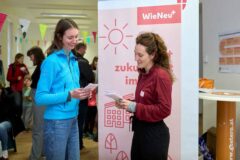
One of these neighbourhoods is the “Alliiertenviertel”5 in Vienna’s 2nd district. As part of the WieNeu+ urban renewal programme, regular fact-finding events and local walks are being organised on the topics of building renovation, funding schemes, housing improvement, expanding and upgrading district heating, and depaving inner courtyards. The aim is to give the area the best possible preparation by 2028 for meeting its climate neutrality target through tailored measures and direct dialogue with tenants and homeowners. The “Climate Pioneers” campaign implemented in 2025 in the Alliiertenviertel highlighted these efforts and selected neighborhood projects.
Alongside financial support for innovative construction measures as part of the WieNeu+ local funding scheme, property owners are personally advised and supported with their renovation and decarbonisation projects. The aim is not only to encourage them to switch from gas to alternative energy carriers but also to strengthen social cohesion at community level.
klimaneutralestadt.at/en/projects/pioneer-cities/klimapionierstadt-wien.php
1 www.wien.gv.at/umwelt/klimarat
2 www.wien.gv.at/umwelt/klimacheck-gesetze
3 www.wien.gv.at/umwelt/klimacheck-bauvorhaben
4 www.wien.gv.at/umwelt/klima-allianz
5 wieneuplus.wien.gv.at/alliiertenviertel-ist-klimapioniergebiet