The city of Krems wants to make its administration climate-neutral by 2030 and achieve climate neutrality in all areas of life and the economy by 2040. One milestone along the way has been the development of a climate relevance tool for assessing municipal decisions, which has also been rolled out across Austria.
“Our climate neutrality roadmap has enabled us to identify what the main levers are, giving us a strategy to pursue over the next few years,” says Stefanie Widhalm, head of the “pioneering city” project. “The roadmap is designed as a living document and shows us where we’re at now, what we want to achieve and where we need to start.”
As part of its “pioneering city” partnership, Krems is setting up a climate office and recruiting additional specialists in construction and the circular economy. For several years now, Krems has been using a new tool– developed together with the Energy and Environment Agency of Lower Austria – to review all municipal council and city council
Driving the energy and mobility transformation forward
With the human factor playing a key role in the transformation process, the city is sharpening its focus on raising awareness, not least through measures aimed at its council staff. A great many steps have also already been taken on the infrastructure front, with several council-owned buildings being fitted with solar panels in recent years. The electricity generated is used as locally as possible via an energy community, while electricity storage systems and energy management systems could help to optimise the system further in the future. Another priority is refurbishing public buildings to make them more thermally efficient. In the mobility sector, meanwhile, the transformation is beginning with the city’s fleet of vehicles, which are to be gradually converted to electric.
Pop-up events as a test
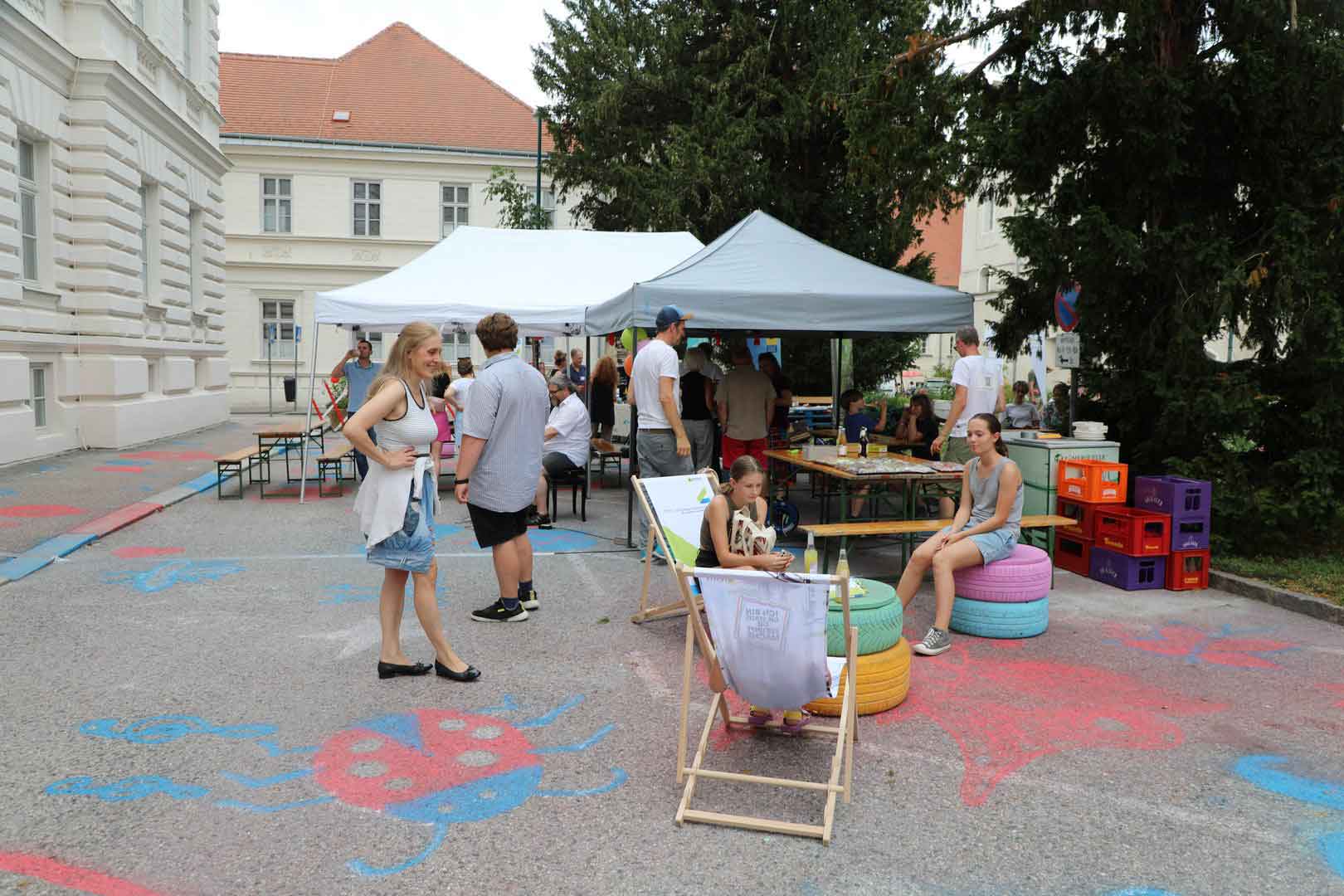
The planned redevelopment of Hafnerplatz in Krems city centre was initially broached with a pop-up event that made use of “tactical urbanism” methods in collaboration with the University for Continuing Education Krems. To enable locals to see for themselves what the planned traffic-calming measures would look like, one street was closed temporarily and the “Hafnerfest” festival was put on alongside various hands-on activities. Residents were also asked about what they thought and what they wanted to see. Feedback was overwhelmingly positive, and the city is now planning to use this method to trial other projects in advance.
Share